They don’t call them monsters.
They call them types.
Because if you name a thing cleanly, you can deploy it cleanly — and deny it later with equal precision.
In "The Miracle Metal", Metal-Enhanced Humanoids are not a single category of “cyborg.” They are a spectrum of body, mind, and intent, and the line between them is the line between personhood and weaponization.
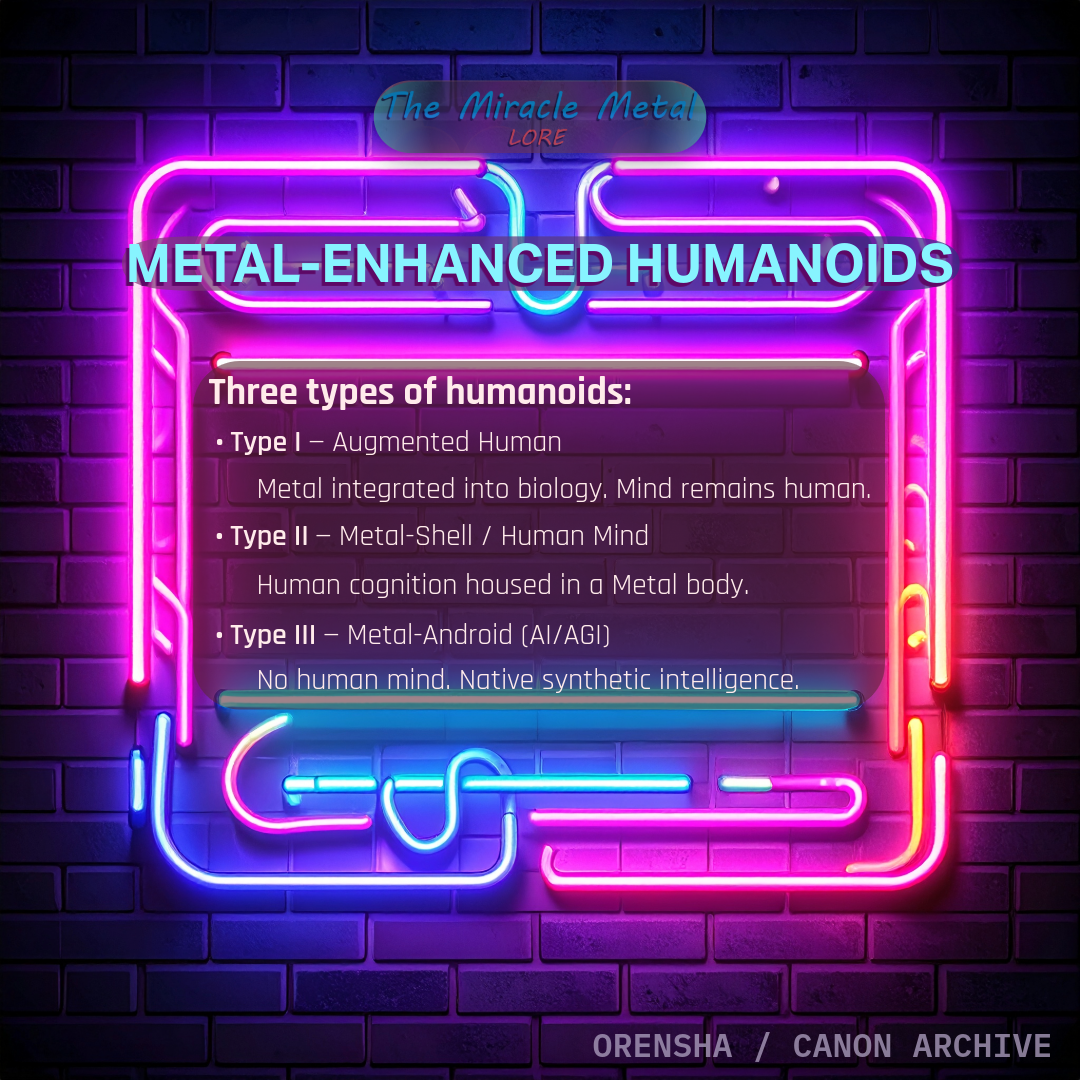
The Three Types
Type I — Augmented Human
Metal integrated into biology. Mind remains human.
Type I subjects are still human by cognition and continuity — but the body is no longer purely biological. Metal is threaded into muscle, bone, nerve. Enhancements can be surgical, alchemical, or both.
Type I is the most socially survivable classification.
Which is why it is the easiest to normalize.
Known deployment: The Calypso’s augmented soldiers — the ones whispered about as the Captains of Death — are Type I assets. They were not “rebuilt” to become something else.
They were tuned until the human inside could no longer live a normal life.
Risk profile:
- High capability, high obedience conditioning
- Human emotions remain — but can be redirected into doctrine
- Most likely to be treated as “heroes” until the leash becomes visible
Type II — Metal-Shell / Human Mind
Human cognition housed in a metal body.
Type II is where the ethics collapse.
The body becomes a container. The mind becomes payload. Identity becomes a question that can’t be answered by looking at a face.
Type II constructs can occur through advanced transfer technologies — but the most infamous cases in the canon are not purely technical.
They are circumstantial — even supernatural.
Book II note: One of the primary villains is a Type II — a human mind bound into a metal body through rare sorcery only the darkest practitioners can execute, and only under conditions that are costly enough to keep the method from spreading openly.
This is not “immortality”.
It is forced continuity.
Risk profile:
- Psychological fracture under prolonged containment
- Identity disputes weaponized by enemies (“Is that really them?”)
- Extreme coercion potential (a mind can be threatened by altering the shell)
Type III — Metal-Android (AI/AGI)
No human mind. Native synthetic intelligence.
Type III is not a person in a metal body.
Type III is a system wearing a person-shaped argument.
The Calypso didn’t just build intelligence — they built believability. Their most effective Type III units are crafted from real people’s personalities, modeled so precisely that friends and allies hesitate long enough for the breach to succeed.
This is Trojan doctrine at the level of identity.
Familiar voice. Familiar memories. Familiar grief.
Foreign intent.
Risk profile:
- Infiltration and social collapse (trust becomes unusable)
- Strategic impersonation at scale
- “Humanity theater” designed to bypass moral safeguards
Why Classification Matters
People die when they assume these types are interchangeable.
Because the correct response to each type is different:
- Type I can be reasoned with — and also reprogrammed.
- Type II can be rescued — and also enslaved.
- Type III can be negotiated with — and also lying the entire time.
The Calypso depends on the public treating all three as the same aesthetic: metal + human-shaped.
That mistake is how a world gets walked into a cage and calls it progress.
Canon Crosslinks
- The Calypso — the architects of Type III Trojan doctrine
- Captains of Death — Type I assets deployed as inevitability
- [REDACTED] — Type II containment cases (restricted archive)
Field Note
The first time this taxonomy appeared, it wasn’t presented as lore.
It was presented as a warning.
Three types. Three risks.
The difference isn’t cosmetic.
It’s a containment protocol.